May 192013
 

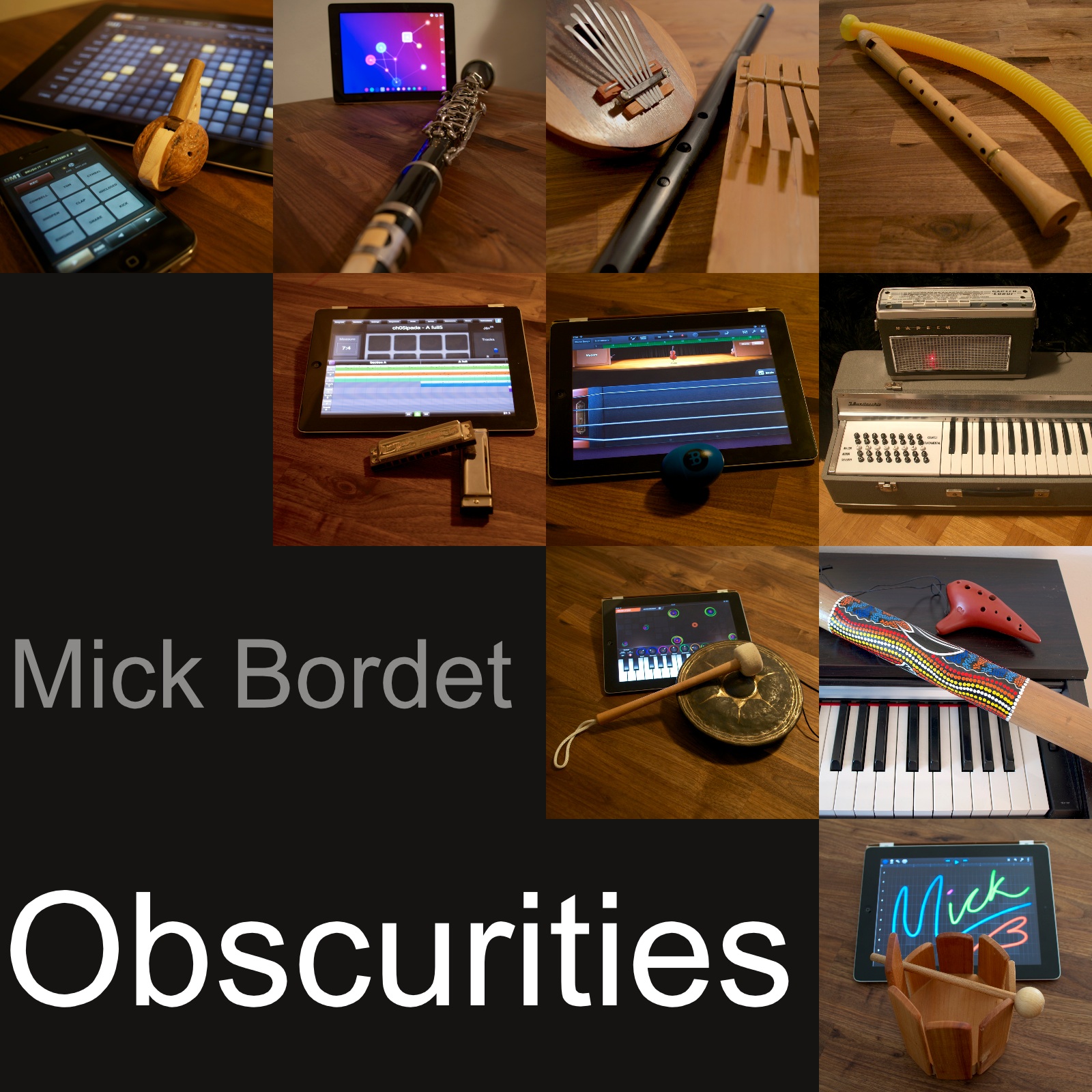
Obscurities CoverAfter some fine-tuning of the music from the ‘10 Weeks : 10 Sounds‘ project, I have compiled it into an album that is now ready to download from Bandcamp.

The music is embedded on the right-hand side of this site, so you can listen to most of the tracks before downloading for a very reasonable price. In addition to the music I have already featured on this site, the final album includes another 16 pieces of music that were recorded at the same time, but not released (these do NOT appear in the track list shown, but are included as bonus tracks in the final download).

The whole album has a Creative Commons (BY-CC) licence, which means you can freely share it, use it in podcasts, films or online projects, just so long as you credit it to Mick Bordet and include a link to this website in whatever you produce.

In addition to the music, the download contains a full-colour pdf booklet that describes each track along with photographs of all the instruments, and a pdf file of a novella that accompanies the music.

The novella (also called “Obscurities”) introduces a character from a forthcoming book, who discovers a box full of instruments and learns the story behind each one: a story that forms her own personal history and leads her to learn about her ancestors and herself. Yes, each of the instruments she finds is one of those used in the album and each has a very different tale to tell.

ObscuritiesBookThe eBook is also available at Smashwords in formats for all the usual eReaders.

As if that wasn’t enough, the story will also be appearing in audio podcast form over the next few weeks at Every Photo Tells…
The audio version of the story includes snippets of music from the album, so is also a good way to hear some of the music and immerse yourself in the story at the same time.

Jan 012013
 
This is part 2 of 12 in the series 10 Weeks - 10 Sounds
NodeBeat & Clarinet

NodeBeat & Clarinet

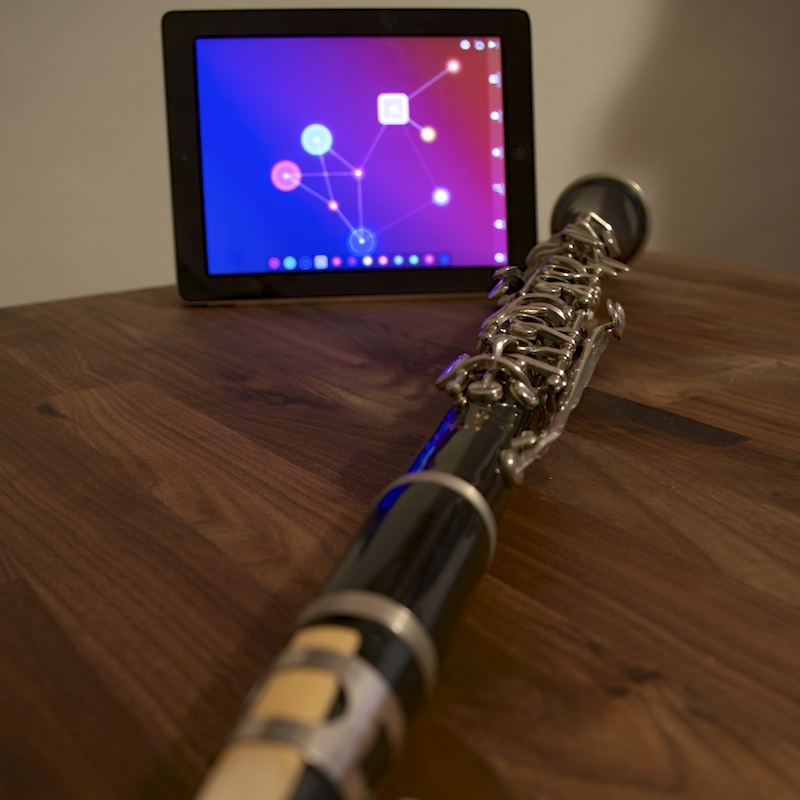
The second challenge for ‘10 Weeks : 10 Sounds‘ is a little more complex than the first and resulted in three long pieces in a fairly laid-back smoky jazz-club sort of style.

NodeBeat is a graphical sequencer for the iPad and iPhone that is simple in concept, but can result in some complex music. It uses a series of ‘nodes’ that trigger either a musical note or a drum beat according to how close the nodes are together. This can be further refined by use of specific scales and waveforms, tempos and transpose levels, as well as the ability to turn on movement and gravity. Under these last options, the nodes move around on their own accord, introducing a gradually changing random factor.

I’ve worked with NodeBeat before, to provide the rhythm for Drei Viertel Drei’s ‘Igor’s Jigsaw‘. For that song Katharina put the rhythm together and I used NodeBeat’s MIDI-out to trigger body part samples; this time I stuck to using NodeBeat’s own sounds, rather than introducing another instrument, but the MIDI facilities really turn the software into a serious tool for creating musical patterns.

The clarinet is a Rudall Carte Graduate model, B-flat, which is a bit of a culture shock for a guitarist used to playing a ‘C’ and hearing the same note. I’ve only used the instrument a few times before, mostly on The Lunacy Board’s ‘Difficult Second‘ album, but I needed to dig around to make sure I was using the right fingerings, since there are rather a lot of keys on a clarinet.

NodeBeat Track 1

NodeBeat Track 1

The first piece uses both NodeBeat’s rhythm and its built-in keyboard. I set up a group of nodes, then switched them all off, before switching them on gradually a few at a time, in-between improvising a lead line with the keyboard. Clarinet parts were then overdubbed, treated with some reverb and a little EQ.

NodeBeat Track 2

NodeBeat Track 2

The second track was created in a similar manner, though I changed the waveform halfway through the piece as well as moving some nodes as the piece was playing. There is a little less keyboard use on this track, leaving room for the clarinet parts to take the lead more than on the first one.

NodeBeat Track 3

NodeBeat Track 3

For the last track, I switched on the movement and gravity options, resulting in the nodes wandering around the screen and creating a more sporadic rhythm that was a little trickier to keep time with, so this piece is shorter and sounds a little more like free jazz than the others. To avoid the rhythm becoming a sludgy mess, I kept the number of nodes to a manageable number, leaving plenty of space in the resulting track.

Dec 192012
 
This is part 1 of 12 in the series 10 Weeks - 10 Sounds

I have been gathering quirky little instruments and musical odds and ends for quite some time and, whilst many of these have made their way into my songs, there are still some that remain stubbornly under-used. We were discussing this a couple of days ago and as a result, Katharina set me a challenge, or rather a series of challenges:

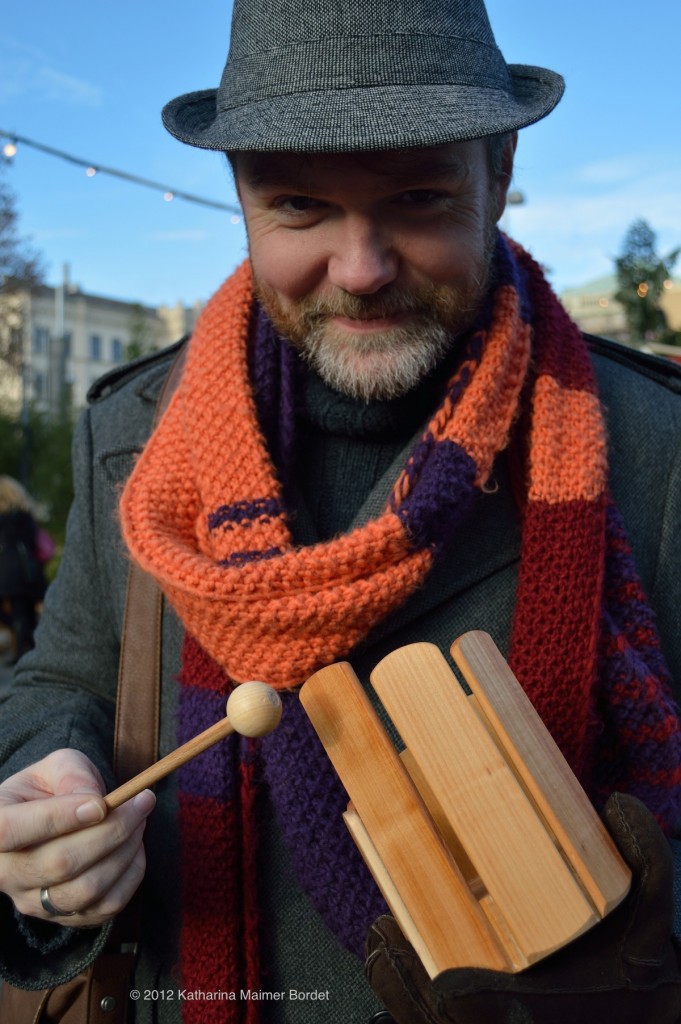
RührTrommel

The Rührtrommel


For 10 weeks you will produce sounds or tunes with the instruments listed below. There is always more than one, which means both need to be used for the melody – not after each other or two different sound snippets. You can record the sounds separately and mix them together later. Once you have recorded the sounds or melodies, you need to blog about it. There’s a prize at the end. Now go out and make a noise!

Week 1 (24.12.2012 – 30.12.2012):
DM1 (iPad App) and Walnut Flute

Week 2 (31.12.2012 – 06.01.2013):
Node Beat (iPad App) and Clarinet

Week 3 (07.01.2013 – 13.01.2013):
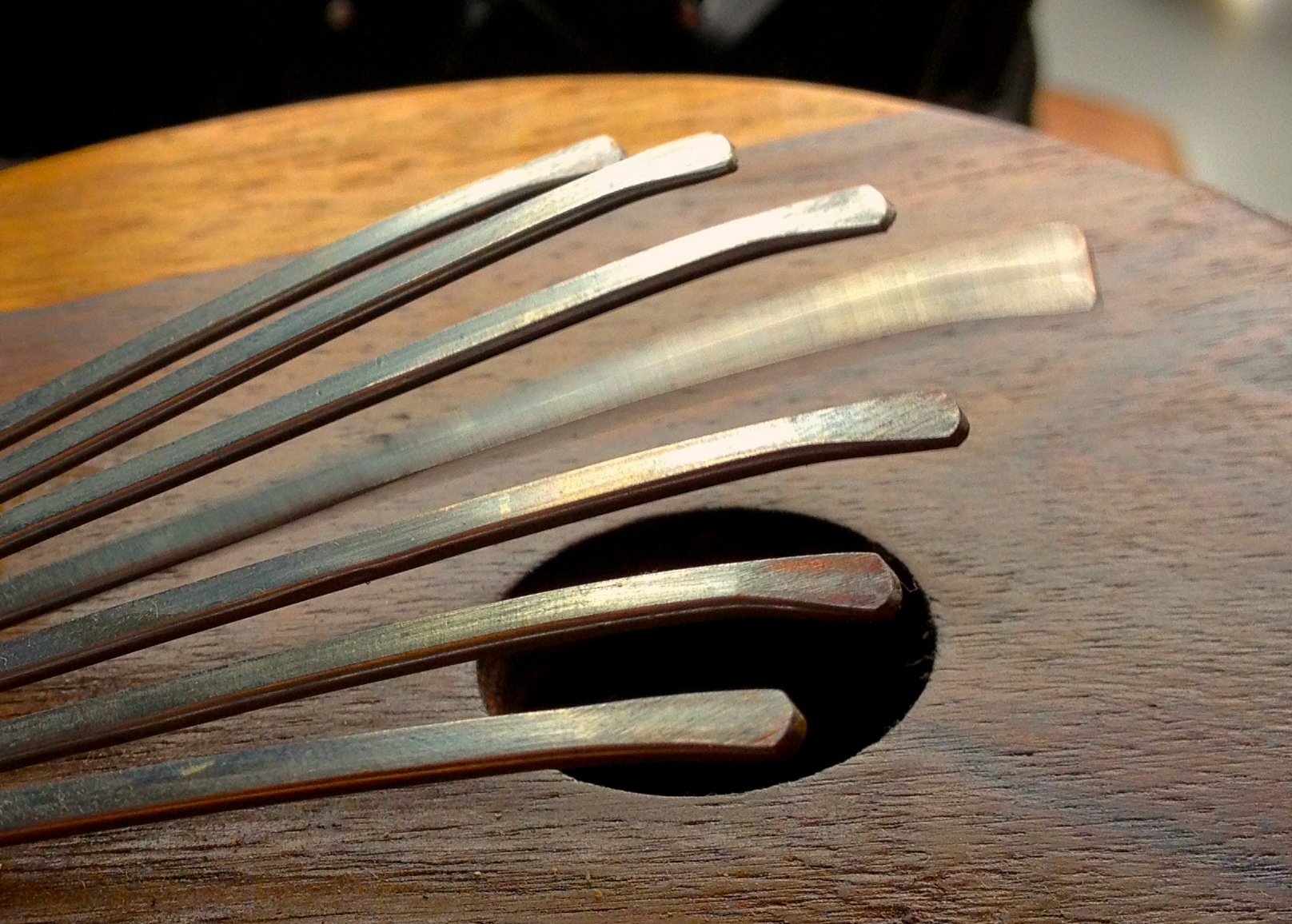
Kalimba and Celtic Flute

Week 4 (14.01.2013 – 20.01.2013):
Alto Recorder and Whirlie

Week 5 (21.01.2013 – 27.01.2013):
Beat Pad (iPad App) and Mouth Organ

Week 6 (28.01.2013 – 03.02.2013):
Garageband and Egg Shaker

Week 7 (04.02.2013 – 10.02.2013):
MeeBlip and Busilaccio Organ

Week 8 (11.02.2013 – 17.02.2013):
Launchkey (iPad App) and Gong

Week 9 (18.02.2013 – 24.02.2013):
Piano, Ocarina and Rainstick

Week 10 (25.02.2013 – 03.03.2013):
Sound Brush (iPad App) and Rührtrommel (stirring drum)

There are some interesting combinations of instruments and software to work with – some of which could be a real challenge to make musical. I’ll post the results here as they are completed!

Jun 052007
 

Inspired in part by Sonicstate’s top 20 greatest synths and Matrixsynth’s The Most Underrated Synths, here is my alternative. This is my top ten list of synths. Not the greatest by any margin, though there are some classics in there. Not the most historically interesting, though one or two certainly have their place in history. Just 10 synths that I’ve enjoyed using over the years, despite or even because of numerous obstacles they’ve thrown in the way. Most were end-of-line bargains or second-hand gems, but they’ve all served me well.

10 Yamaha FB01

FB01

For such a little unit this comes with one of the most comprehensive and awe-inspiring manuals complete with extensive MIDI implentation charts and sysex data. The sound out of this is not great – 4-operator FM is not going to win many prizes these days, or even in the days it was first launched. However it is 8-part multitimbral, which was pretty impressive at its launch, and it does work will for a filler. I usually use it for background layers of choirs, brass or synth strings.

9 Casio CZ1000

CZ1000

Casio didn’t stay in the pro synth market for long, but the CZ series has endured. In theory it is a variant on FM synthesis, but in practice it is much easier to program and tends to sound a bit warmer, with some great synth bass sounds and a nice line in brass blasts. This is the full-sized keyboard version of the very popular CZ101. I don’t use mine very often these days as it is a big keyboard to house for the sake of its 4-note polyphony, but it does get dug out every so often to bring its own charm to the occasional piece.

8 Yamaha PSS780

PSS780

This is a pretty wretched FM workstation with mini-keys, built-in drum pads, sequencer, auto-accompaniment, effects and basic synthesis controls. It is generally pretty weedy sounding, with less oomph than half a FB01 on a bad day, and is really a home keyboard with pretensions of being a synth. However, it is multi-timbral and MIDI-controllable and when the sounds are layered up and a decent drum pattern programmed, it can sound okay. Add some real guitar and vocals and you might just pull it off. This was the first ‘synth’ I had that I could control via MIDI, and it more than doubled the range of sounds I had available at the time. For that I pay it my respect.

7 Akai S950

S950

Akai were several generations of their legendary samplers on by the time I joined the fray with this 3rd-hand bargain. Only 12-bit sample quality, but with all the bells and whistles of the pro favourite S1000, the S950 was quickly pressed into service as an enhancement to the meagre drum sounds of the PSS780, allowing me to mix professionally recorded samples with yobstick, bucket and kalimba samples amongst others, adding more detail to drum parts. I never did manage to get hold of the SCSI disk interface for it, so to this day I have to load it up with several floppy disks, which puts me off using it as much as I might do.

6 Yamaha DX7

DX7

What need I say about the DX7. THE classic late 80′s synth. Wonderful electric pianos and bells, wonderful evolving FM washes and great hammered percussion. It is a beast to program, but blessed with a bucketful of computer programs to make it easier, and my first synth was FM-based, so I was in familiar territory. The DX is still my master keyboard for controlling synths, though only occasionally do I use the on-board sounds – usually only for piano or pads. Mine is a mk1, with limited MIDI capabilities, annoyingly curtailed keyboard response and horrible membrane buttons, but it still has a great feel, is built like a tank and is easy to fall back on.

5 Kawai K4R

K4r

My first foray into Sample+Synthesis was with the K4r, the rackmount version of the K4. It took the place of the PSS780 as a general dogbody machine with a good collection of drum kits, 16-part multitimbral sound source and a selection of waveforms suitable for everthing from acoustic guitar to analogue lead synths with a filter section good enough to do it justice. I still use this regularly, and probably still could find new things to do with it.

4 Yamaha TX81Z

TX81Z

Another 4-operator Yamaha FM synth, but this one’s a little bit special. First of all it has a significantly improved synthesis engine over the old FB01, with a wide range of waveforms to base sounds on. Secondly it has the ability to store micro-tunings for more experimental music. Thirdly it has good support for breath controllers, making it an ideal partner for my Casio digital wind controller (DH100). It also has a range of good software supporting editing, which is just as well since it has a DX7-like unfriendly editing system. Like the DX it is great for metallic sounds and crisp basses.

3 Moog Etherwave Pro

E-Pro

It’s a theremin – does that count as a synth? I say yes. It’s my list. It is the top of the range Moog theremin and a thing of beauty. Curved walnut surface with gleaming chrome knobs. It is has a nice linear playing range, classic preset tones and enough filter and tone controls to provide a wide range of sounds from pure voices to cutting sawtooth buzzes, as well as CV controls for controlling analogue synths like a theremin. It’s my favourite of all the sound creating gadgets I have, but there are two more items that are currently in the lead for historic reasons.

2 Casio CSM10P

CSM10

This is a tacky little black box with only 5 sounds – electric piano, piano, organ, harpsichord and vibes. I think it uses 12-bit samples – they’re certainly not great quality. It is preset-only with no editing, being designed to plug in and expand a home keyboard. I have used it time and time again, especially the piano and vibes, and it always wins me over with its simplicity. Just select the sound and play. Nothing more to it. It does have pretty good polyphony, or at least good enough for my keyboard playing, and I find the sounds sit comfortably in a mix (though the pipe organ can be a bit overwhelming at times). It really shouldn’t get used as much as it does, but I just can’t help it. Try listening to Yet Another Granfalloon (pt1) for an example of it in action.

1 Yamaha CX5M

CX5

WHAT? Surely I’m joking? Well, no. I cut my electronic / MIDI / composing / keyboard teeth on this bizarre creature, and for all of its many, MANY faults, it holds a slightly rose-tinted place in my musical heart. When I had the opportunity to buy my first keyboard, some time after The Deserters were formed, I spent endless hours scrutinising music magazines for the best synth for me. I had a few front-runners, including the DX100 and CZ101 which had just come out, though I wasn’t too keen on their small keys. Then the CX5M Music Computer came to the end of its commercial life and dropped significantly in price – I was able to pick up the equivalent in sound quality to a DX9, with in-built computer and sequencer for about the same as a CZ101. I pontificated for a while over this, even passing over the opportunity to pick up a Korg MS10 for 50 quid (ha ha, how very different things could have been had I gone down that route…), but eventually came to the conclusion that it was too good a deal to miss.

I wasn’t aware that it couldn’t be played from another MIDI keyboard, despite the presence of a MIDI in socket, so that blew the longevity of it out the water. The only useful sequencer for it at the time was the step sequencer which required some very tedious manual progamming. And the included keyboard was pretty pathetic. However, like so many limited things, these drawbacks just focused the use of the thing, and I soon got my head around FM synthesis using the built-in editor, complex harmonies and rhythms with the score composer sequencer, and drum programming by linking it up to a ZX Spectrum with “SpecDrum” fitted. So it was flawed, but it formed the musical base for a large number of Deserters tunes, try Phill Up the Glass to hear it in action, but most notably the 20-minute-plus instrumental extravaganza that was “Mick’s Amazing Megamix”. Unfortunately the only version of this recorded comes from a badly distorted tape – it has been converted into a more modern sequencer format so may eventually see the light of day using the TX81z to emulate the CX5 tones.

So that’s the lot. Not to everyone’s taste, and probably more biased in favour of a certain Japanese manufacturer than I would like, but impoverished gear junkies can’t be choosers.

May 312007
 

I came across a Yahoo group yesterday that I thought might be of interest (Novelty Music), and this morning heard back from founder member Paul Moore. Paul has a one-man-band and plays the ‘Zob Stick’ which, upon further investigation, turns out the be one of many names for what we know as the Yobstick.

Whilst I have heard of others playing similar stick-based instruments every so often, I had never heard of the name. I suspect the name ‘Yobstick’ may just be due to a mispronunciation of ‘Zob Stick’, but the instrument has also been called the ‘Monkey Stick’, ‘Lagerphone’, ‘Freedom Boot’ and many other names from around the world. In fact it has a history going back to asian shamans, and possibly beyond, where it was used as a symbol of power. I’ve stuck some more details about this up on the Deserters site, along with links to some related sites.

For me the most interesting of these is The Groanbox Boys – a London band who I had already heard about in the last couple of days as they just happen to feature Michael Ward-Bergman. He plays some superb accordian (yes, perhaps it seems like a contradiction of terms, but it is really VERY good) on Judge Smith’s album, “The Full English“.

The New Yobstick

 The Deserters  Comments Off
May 202007
 

At last, I finally got around to finishing the new yobstick. It’s quite a departure from previous efforts – lots of natural wood and more emphasis on playability instead of durability. I’ve only played it for a short time tonight, but it feels great and sounds lovely (far better than a stick with a welly at one end and a load of bottle tops at the other should do!)

I’ll stick some audio clips up once I’ve worked out how to mic the damn thing up. Imagine a drum kit that moves… I may need to get contact mics for it to work, but it is in effect three linked sound sources, so a single mic won’t do it justice, and certainly wouldn’t make it easy to be heard over electric instruments.

This picture of it makes it look somewhat scrawny, but looks aren’t everything. I’ve set out the process I used to put it together over on the Deserters’ page, under Instrumentography, so you can get a flavour for what is required to build one, and find out really interesting facts like “who makes the best bottletops for a yobstick?”

I’ve also been experimenting with some software called “SooperLooper”, which turns a standard Linux PC into a long controllable delay loop. I’ve worked out how to get some control over it with my guitar effects pedal, to the extent of being able to play a series of chords, then bass, then solo over the top. Once I’m more familiar with it I’m hoping to be able to set up a rhythm with the yobstick and guitar, then play theremin over the top. Early days, but if I can get it working together and hit the timing spot on, then it could sound pretty good.

Nov 202006
 

J Busilacchio Reed Organ

Since the days of the Green Shed Studios and the big Farfisa organ we had there, I’ve always had a bit of a soft spot for the sound of the organ. Nothing else sounds like a proper pipe organ being played well in a cathedral and echoing round the space, filling the audio spectrum with trouser-flapping bass and angelic overtones. And the latest addition to my sonic arsenal fits the bill – it sounds nothing like that, but perhaps a bit more like an asthmatic monk playing an accordion in a public toilet.

Introducing the J. Busilacchio electric reed organ – it’s a keyboard in a suitcase, includes 4 legs which screw in to the bottom and an on/off switch. Turn it on and a fan starts pumping a cool breeze across your fingers and you’re ready to go. It has a great sound – effectively it’s a harmonium without the bellows, or a horizonal accordion. The air gets pumped over metal reeds which results in a rich sound a bit like a pipe organ with a bad cold – not as bold or clear, but with a dignified, if slightly dishevelled, air. It’s defintely more Ivor Cutler than Van der Graaf Generator, but that’s certainly no bad thing. It sits quite well with theremin, so I may create something to feature the two together.

There’s really not a lot of information available about these – they do crop up fairly regularly in online auctions, along with similar items by other manufacturers. I’ve seen them described as dating from the 40′s, which I find a little hard to believe, as they have more of a 60′s feel to them. They’re also known as Chord Organs, due to the panel of accordion-like chord buttons to the left of the keyboard, though this tends to lump them in with some pretty ugly-looking plastic things with plastic reeds which really are not in the same league. If anyone has more information about the history of these critters, let me know.

UPDATE

I’ve done some more digging around, and discovered various different versions of the organ. I’ve put details on a new page on the Deserters site, here.

Note to eBay sellers: You are welcome to use the details about Busilacchio/Lorenzo organs from this page on the condition that you include a link to this page (http://www.the-deserters.co.uk/inst_organs.html) on your listing so that your potential buyers have access to all the information.

Farfisa Frenzy

 The Deserters  Comments Off
Aug 302006
 

For some reason, perhaps Google have recently updated their index, there has been a large jump in visits to the blog here, 90% of which are from a Google Images search on Farfisa. The post from April this year Makkie’s Rhythm included a picture of a Farfisa organ, which is now appearing as 4th in a google search. All very nice, but apologies to anyone searching for information about Farfisa organs here – I don’t have any!

Well, okay, here’s some background about the one we used… It came from some club or other and was on its last legs when it arrived at the Green Shed for us to use. It had a solid veneer of nicotine mottled with beer and grew progressively smellier as it warmed up with use. I don’t know what model it is – I did a bit of research recently for more information, but came up with very little, but it had a built-in rhythm section (as used in the aforementioned track) and tape recorder. It also supposedly had a Leslie cabinet built in, but the switch to turn it on did nothing. At the time none of us had any idea what a Leslie was, sowe didn’t realise what we were missing, or even how we could go about fixing it to get that unique sound. Oh well. At the time we did think it was an incredibly cheesy addition to our instrumental ranks, but it served us well whilst it lasted.

Unfortunately, one day it just died in a shower of sparks and our association was almost over. I did manage to salvage the rhythm unit from it and get it operating as a stand-alone analogue drum machine of sorts. It was not programmable, but you could jam two or three rhythm type buttons down together to create new composite and quite dense mega-rhythms, which was pretty nifty. I don’t know what happened to that part of it, though – I can only assume it was ‘lost’ in a house move.

Moog Envy

 Instruments  Comments Off
Mar 292006
 

The new Moog Little Phatty

Being a bit of a skinflint, almost all of my musical gear is either second-hand or end-of-line stock, but I’ve got a deep hunger for the new Moog synth. It’s the last project from the legendary Dr Bob, and what a send-off it is. It definitely looks like a Minimoog for the neext century.

Not only does it have all the usual MIDI paraphenalia required of today’s digital synths, but it has several CV inputs that are just begging to have my Etherwave Pro plugged into them. I want one of these. Really very much. But I know it will be at least a year away before I can even consider thinking about it.

I haven’t forgotten about ‘Track of the Week’ either, just been incredibly busy this last week or so, and will make it up to you with 2 tracks for this week.

Theremin Update #1

 Instruments  Comments Off
Mar 172006
 

I thought I’d put a little bit of blurb up here about my progress with the theremin. After a couple of months with no progress, mainly due to not being able to find somewhere suitable for it to live, I’ve now got into a good routine of having a practice at least once a day. So far I’m now getting the hang of aerial fingering, so I’m able to do some short runs without wobbling all over the place, and getting a feel for some common intervals. I can pull off an ascending scale, but descending is a bit more tricky for some reason. And finally, I’m able to play some basic and actually recognisable tunes.

I’ve done all this just by ear so far, with my acoustic guitar close at hand for occasional assistance, so my next step is going to be to get a sound source to try and play along with some pre-recorded music. Trying to keep in tune with another instrument could well prove to be more tricky than keeping in tune with myself. We shall see (hear). Hopefully, in another couple of weeks I should be ready to put some theremin parts down onto some tracks I have set aside, albeit pretty basic ones. That’ll be the acid test.

My previous post about the clarinet has just been included on MusicThing – I’m quite honoured. Thanks Tom!